

No products in the cart.
Uncategorized
What States Ban Spores in the US?
17
Apr
Apr
If you are trying to figure out what states ban spores, you are probably not looking for vague legal fluff. You want the short answer, the real-world answer, and the kind of clarity that helps you avoid a dumb shipping mistake. In the US, psilocybin mushroom spores are generally legal to possess for microscopy and taxonomy purposes in most states, but a few states treat them differently.
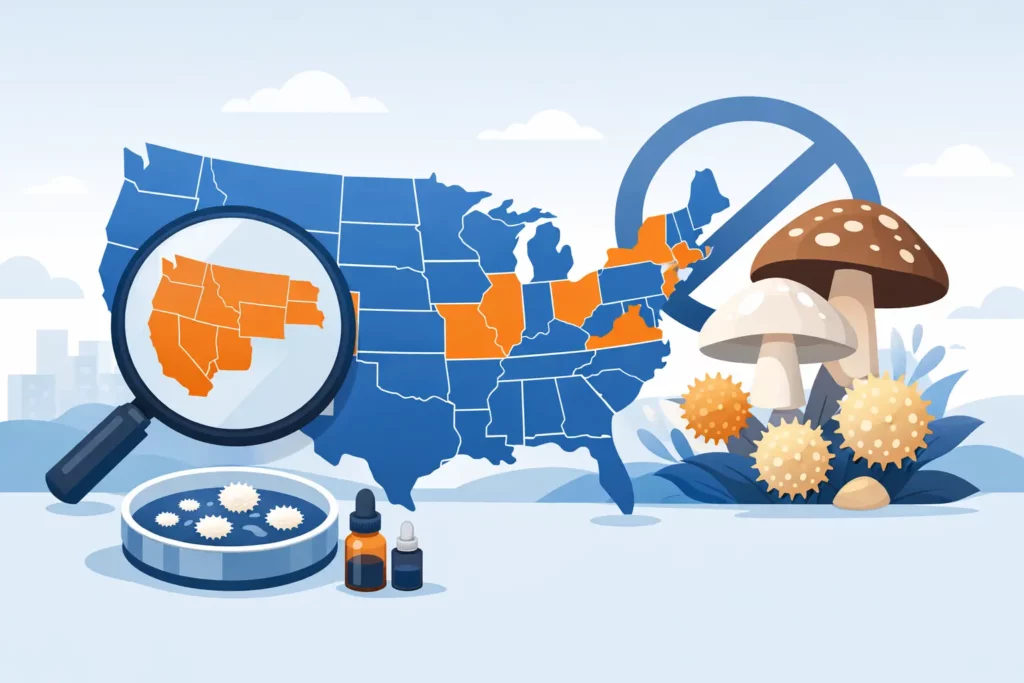
The big ones are California, Georgia, and Idaho. Those are the states most commonly recognized as banning or heavily restricting psilocybin mushroom spores. If you are shopping online, those are the names that matter first, because many retailers will not ship spore syringes, prints, or related microscopy products to addresses in those states.
What states ban spores?
For most buyers, the answer starts and ends with three states: California, Georgia, and Idaho.
Those states are widely treated as the main no-ship or restricted destinations for psilocybin mushroom spores because their laws go beyond the usual federal distinction. Under federal law, spores themselves do not contain psilocybin or psilocin. That is why they have long existed in a legal gray area and are commonly sold for research, microscopy, and taxonomy. But state law can be stricter than federal law, and in these three states, it usually is.
That matters because legality is not just about what is inside the spore. It is also about how a state defines mushroom materials, intent, and prohibited substances related to cultivation. Even when a product is marketed for microscopy, states with stricter language can create real risk for both seller and buyer.
Why California, Georgia, and Idaho are different
California surprises people because it is seen as progressive on a lot of drug policy issues. But psilocybin spore restrictions are one of those areas where the law does not match the vibe. California has long been treated as off-limits for psilocybin mushroom spores by serious vendors.
Georgia also tends to show up on every restricted list. The state takes a tighter view of materials connected to psilocybin mushrooms, which is why reputable sellers usually block spore shipments there.
Idaho is the strictest name in the bunch and has one of the most hardline reputations in the country when it comes to anything related to psilocybin mushrooms. If you see a vendor warning about banned states, Idaho is almost always there.
This is where buyers get tripped up. They assume that because spores do not contain active compounds, they must be legal everywhere. That is not how this works. The gray area exists only until a state decides to write around it.
What about the rest of the US?
In most other states, psilocybin spores are usually sold and possessed under the research-only framing. That means microscopy, strain identification, and taxonomy are the standard legal use cases attached to the product.
But legal in theory does not always mean risk-free in practice. State laws change. Local enforcement can vary. Retailers may also create their own shipping rules that are stricter than the law because they do not want payment, compliance, or package seizure issues.
So if you are outside California, Georgia, and Idaho, that does not automatically mean every product can ship to you with zero complications. It usually means you are in a more workable zone, not a guaranteed one.
The federal angle buyers always ask about
At the federal level, the key distinction is simple: psilocybin and psilocin are controlled substances, but spores do not contain those compounds. That is why spores have historically been sold as microscopy products.
The catch is intent. Once the conversation shifts from observing spores under a microscope to germination and cultivation of psilocybin-producing mushrooms, the legal picture changes fast. That is the line most vendors are trying to stay on, at least on paper.
This is also why you will see the same language over and over across the market – microscopy use, research use, taxonomy use, and no cultivation claims. It is not random branding. It is a legal shield, even if everyone understands the broader culture around mushroom spores.
What states ban spores and what buyers should actually watch for
The state list matters, but the shipping policy matters too. Even if your state is not on the classic restricted list, a seller may decline your order based on internal compliance rules, product type, or how local laws are evolving.
Spore prints, spore syringes, and isolated genetics may not all be treated with the same comfort level by every retailer. Some vendors get more cautious with liquid formats. Others restrict anything that looks too close to cultivation support. A smart buyer checks the seller’s current policy before assuming a cart will clear.
If you are using crypto for privacy and convenience, that makes this even more important. Crypto can simplify payment, but it does not erase shipping restrictions or state-level law. If an address is blocked, it is blocked.
Why online stores are careful about restricted states
From the outside, it can look like retailers are being overly cautious. From the inside, it is simple. Shipping into a restricted state can create chargeback headaches, lost package disputes, legal exposure, and platform risk.
That is why established psychedelic retailers tend to be direct about where they will and will not send spores. Clear no-ship rules protect the business and save the buyer from placing an order that cannot be fulfilled.
For a store that carries a mix of research-oriented spore products, microdosing items, and broader psychedelic formats, drawing that line matters even more. It keeps the catalog usable without turning every checkout into a legal gamble.
Common confusion around decriminalized cities and states
Another thing people mix up is decriminalization versus legality. A city may deprioritize enforcement around psilocybin, or a state may soften penalties around certain entheogenic substances, but that does not automatically mean spores are fully legal to ship, sell, or possess without restrictions.
Decriminalization is not the same as full commercial legality. It often means law enforcement resources are redirected, not that all related products are freely regulated and approved. That difference matters a lot when you are ordering online.
So if you heard that mushrooms are “basically legal” in some place, do not assume that applies cleanly to spore shipping. The legal culture may be changing, but store policies usually move slower than rumors.
The smartest way to think about spore legality
The cleanest mindset is this: spores live in a narrow lane. In many states, they are tolerated when framed as microscopy and taxonomy products. In California, Georgia, and Idaho, they are broadly treated as banned or restricted. Everywhere else, the details still matter.
That means you should look at three things every time: your state, the retailer’s current shipping rules, and the specific product format. If all three line up, great. If one does not, forcing the order is not worth it.
Buyers who stay sharp on this avoid the usual headaches. No guessing. No Reddit-lawyer logic. No assuming one old forum post is still accurate five years later.
For people moving through the psychedelic space with curiosity and intention, legality is part of the terrain. Whether you are here for microscopy, strain research, or just trying to understand the market before placing an order, knowing what states ban spores keeps your next move cleaner. When in doubt, slow down, verify the current policy, and keep your research as dialed in as your interest.
